
Sunday, April 1, 2012

Vincent van Gogh
Vincent van Gogh: "I'd like to show by my work what such an eccentric, such a nobody, has in his heart"
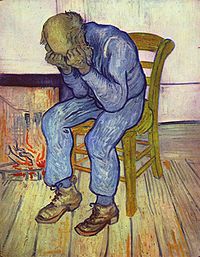
How a genius feels: "I'm a nonentity, an eccentric, an unpleasant person"
March 30th is the birthday of Vincent van Gogh, born in Holland in 1853, a famous painter and also great letter-writer. His letters were lively, engaging, and passionate; they also frequently reflect his struggles with bipolar disorder.
He wrote: "What am I in the eyes of most people — a nonentity, an eccentric, or an unpleasant person — somebody who has no position in society and will never have; in short, the lowest of the low. All right, then — even if that were absolutely true, then I should one day like to show by my work what such an eccentric, such a nobody, has in his heart."
He wrote thousands of letters to his brother Theo over the course of his life. Theo's widow published the van Gogh's letters to her husband in 1913.
- Be kind, for everyone you meet is fighting a great battle.
Image source: Vincent van Gogh's 1890 painting At Eternity's Gate. Wikipedia, public domain.
Wednesday, March 28, 2012
Leymah Gbowee: Unlock the intelligence, passion, greatness of girls
Message of Hope
Leymah Gbowee: Unlock the intelligence, passion, greatness of girls - YouTube
by TEDtalksDirector on Mar 28, 2012 http://www.ted.com Nobel Peace Prize winner Leymah Gbowee has two powerful stories to tell -- of her own life's transformation, and of the untapped potential of girls around the world. Can we transform the world by unlocking the greatness of girls?
Sunday, March 25, 2012
Again: Red Meat Hurts!!!
This article is presented to contrast the fact that a large portion of the world's population goes to bed hungry. Yet certain rich societies enjoy so much of the most expensive protein source - red meat that it can become a hazard to good health.
All red meat is bad for you, new study says - latimes.com
Copyright © 2012, Los Angeles Times
All red meat is bad for you, new study says
A long-term study finds that eating any amount and any type increases the risk of premature death.
By Eryn Brown, Los Angeles Times
March 12, 2012, 4:28 p.m.
Eating red meat — any amount and
any type — appears to significantly increase the risk of premature
death, according to a long-range study that examined the eating habits
and health of more than 110,000 adults for more than 20 years.
For instance, adding just one 3-ounce serving of unprocessed red meat — picture a piece of steak no bigger than a deck of cards — to one's daily diet was associated with a 13% greater chance of dying during the course of the study.
FOR THE RECORD:
Red meat: An article in the March 13 LATExtra section about a study linking red meat consumption to an increased risk of premature death said that preservatives like nitrates probably contributed to the danger. It should have included nitrites as well. —
Even worse, adding an extra daily serving of processed red meat, such as a hot dog or two slices of bacon, was linked to a 20% higher risk of death during the study.
"Any red meat you eat contributes to the risk," said An Pan, a postdoctoral fellow at the Harvard School of Public Health in Boston and lead author of the study, published online Monday in the Archives of Internal Medicine.
Crunching data from thousands of questionnaires that asked people how frequently they ate a variety of foods, the researchers also discovered that replacing red meat with other foods seemed to reduce mortality risk for study participants.
Eating a serving of nuts instead of beef or pork was associated with a 19% lower risk of dying during the study. The team said choosing poultry or whole grains as a substitute was linked with a 14% reduction in mortality risk; low-fat dairy or legumes, 10%; and fish, 7%.
Previous studies had associated red meat consumption with diabetes, heart disease and cancer, all of which can be fatal. Scientists aren't sure exactly what makes red meat so dangerous, but the suspects include the iron and saturated fat in beef, pork and lamb, the nitrates used to preserve them, and the chemicals created by high-temperature cooking.
The Harvard researchers hypothesized that eating red meat would also be linked to an overall risk of death from any cause, Pan said. And the results suggest they were right: Among the 37,698 men and 83,644 women who were tracked, as meat consumption increased, so did mortality risk.
In separate analyses of processed and unprocessed meats, the group found that both types appear to hasten death. Pan said that at the outset, he and his colleagues had thought it likely that only processed meat posed a health danger.
Carol Koprowski, a professor of preventive medicine at USC's Keck School of Medicine who wasn't involved in the research, cautioned that it can be hard to draw specific conclusions from a study like this because there can be a lot of error in the way diet information is recorded in food frequency questionnaires, which ask subjects to remember past meals in sometimes grueling detail.
But Pan said the bottom line was that there was no amount of red meat that's good for you.
"If you want to eat red meat, eat the unprocessed products, and reduce it to two or three servings a week," he said. "That would have a huge impact on public health."
A majority of people in the study reported that they ate an average of at least one serving of meat per day.
Pan said that he eats one or two servings of red meat per week, and that he doesn't eat bacon or other processed meats.
Cancer researcher Lawrence H. Kushi of the Kaiser Permanente Division of Research in Oakland said that groups putting together dietary guidelines were likely to pay attention to the findings in the study.
"There's a pretty strong supposition that eating red meat is important — that it should be part of a healthful diet," said Kushi, who was not involved in the study. "These data basically demonstrate that the less you eat, the better."
UC San Francisco researcher and vegetarian diet advocate Dr. Dean Ornish said he gleaned a hopeful message from the study.
"Something as simple as a meatless Monday can help," he said. "Even small changes can make a difference."
Additionally, Ornish said, "What's good for you is also good for the planet."
In an editorial that accompanied the study, Ornish wrote that a plant-based diet could help cut annual healthcare costs from chronic diseases in the U.S., which exceed $1 trillion. Shrinking the livestock industry could also reduce greenhouse gas emissions and halt the destruction of forests to create pastures, he wrote.
eryn.brown@latimes.com
For instance, adding just one 3-ounce serving of unprocessed red meat — picture a piece of steak no bigger than a deck of cards — to one's daily diet was associated with a 13% greater chance of dying during the course of the study.
FOR THE RECORD:
Red meat: An article in the March 13 LATExtra section about a study linking red meat consumption to an increased risk of premature death said that preservatives like nitrates probably contributed to the danger. It should have included nitrites as well. —
Even worse, adding an extra daily serving of processed red meat, such as a hot dog or two slices of bacon, was linked to a 20% higher risk of death during the study.
"Any red meat you eat contributes to the risk," said An Pan, a postdoctoral fellow at the Harvard School of Public Health in Boston and lead author of the study, published online Monday in the Archives of Internal Medicine.
Crunching data from thousands of questionnaires that asked people how frequently they ate a variety of foods, the researchers also discovered that replacing red meat with other foods seemed to reduce mortality risk for study participants.
Eating a serving of nuts instead of beef or pork was associated with a 19% lower risk of dying during the study. The team said choosing poultry or whole grains as a substitute was linked with a 14% reduction in mortality risk; low-fat dairy or legumes, 10%; and fish, 7%.
Previous studies had associated red meat consumption with diabetes, heart disease and cancer, all of which can be fatal. Scientists aren't sure exactly what makes red meat so dangerous, but the suspects include the iron and saturated fat in beef, pork and lamb, the nitrates used to preserve them, and the chemicals created by high-temperature cooking.
The Harvard researchers hypothesized that eating red meat would also be linked to an overall risk of death from any cause, Pan said. And the results suggest they were right: Among the 37,698 men and 83,644 women who were tracked, as meat consumption increased, so did mortality risk.
In separate analyses of processed and unprocessed meats, the group found that both types appear to hasten death. Pan said that at the outset, he and his colleagues had thought it likely that only processed meat posed a health danger.
Carol Koprowski, a professor of preventive medicine at USC's Keck School of Medicine who wasn't involved in the research, cautioned that it can be hard to draw specific conclusions from a study like this because there can be a lot of error in the way diet information is recorded in food frequency questionnaires, which ask subjects to remember past meals in sometimes grueling detail.
But Pan said the bottom line was that there was no amount of red meat that's good for you.
"If you want to eat red meat, eat the unprocessed products, and reduce it to two or three servings a week," he said. "That would have a huge impact on public health."
A majority of people in the study reported that they ate an average of at least one serving of meat per day.
Pan said that he eats one or two servings of red meat per week, and that he doesn't eat bacon or other processed meats.
Cancer researcher Lawrence H. Kushi of the Kaiser Permanente Division of Research in Oakland said that groups putting together dietary guidelines were likely to pay attention to the findings in the study.
"There's a pretty strong supposition that eating red meat is important — that it should be part of a healthful diet," said Kushi, who was not involved in the study. "These data basically demonstrate that the less you eat, the better."
UC San Francisco researcher and vegetarian diet advocate Dr. Dean Ornish said he gleaned a hopeful message from the study.
"Something as simple as a meatless Monday can help," he said. "Even small changes can make a difference."
Additionally, Ornish said, "What's good for you is also good for the planet."
In an editorial that accompanied the study, Ornish wrote that a plant-based diet could help cut annual healthcare costs from chronic diseases in the U.S., which exceed $1 trillion. Shrinking the livestock industry could also reduce greenhouse gas emissions and halt the destruction of forests to create pastures, he wrote.
eryn.brown@latimes.com
Wednesday, February 15, 2012
Monday, February 13, 2012
Wednesday, January 18, 2012


Thursday, December 15, 2011
Its a Mean Old World
THIS SHOULD ENCOURAGE THE POPULACE TO EMBRACE THE OCCUPY WALL STREET PROTEST.
Census shows 1 in 2 people are poor or low-income
- HOPE YEN, Associated Press
“If Americans ever allow banks to control the issue of their currency, first by inflation and then by deflation, the banks will deprive the people of all property until their children will wake up homeless.”
- Thomas Jefferson
"One of the funny things about the stock market is that every time one person buys, another sells, and both think they are astute."
- William Feather
One in Two Americans are Poor
According to new supplemental data from the Census Bureau, nearly half of Americans have fallen under the poverty line or are classified as “low income” .
................................................................................
Census shows 1 in 2 people are poor or low-income
By HOPE YEN, Associated Press
Census shows 1 in 2 people are poor or low-income
By HOPE YEN, Associated Press
WASHINGTON (AP) — Squeezed by rising living costs, a record number of Americans — nearly 1 in 2 — have fallen into poverty or are scraping by on earnings that classify them as low income.
'Stagflation':
The latest census data depict a middle class that's shrinking as unemployment stays high and the government's safety net frays. The new numbers follow years of stagnating wages for the middle class that have hurt millions of workers and families.
About 97.3 million Americans fall into a low-income category, commonly defined as those earning between 100 and 199 percent of the poverty level, based on a new supplemental measure by the Census Bureau that is designed to provide a fuller picture of poverty. Together with the 49.1 million who fall below the poverty line and are counted as poor, they number 146.4 million, or 48 percent of the U.S. population. That's up by 4 million from 2009, the earliest numbers for the newly developed poverty measure.
*146.4 million people represents a huge number of votes.
A survey of 29 cities conducted by the U.S. Conference of Mayors released Thursday points to a gloomy outlook for those on the lower end of the income scale.
Many mayors cited the challenges of meeting increased demands for food assistance, expressing particular concern about possible cuts to federal programs such as food stamps and WIC, which assists low-income pregnant women and mothers. Unemployment led the list of causes of hunger in cities, followed by poverty, low wages and high housing costs.
Many people in the U.S. are in dire straights and with the cost of bank bailouts and two wars the government does not have much stored wealth to provide the 'safety nets' people need.
If you have shopped in Walmart lately, you know few goods are made in North America. In order to ensure a steady stream of cheap consumer products, America has moved jobs overseas and the effects of that failed policy are beginning to show. Stagflation, falling house prices and few well-paying jobs leaves one feeling hopeless. Is this nearly the bottom in the economic cycle? Things always look thier worst at the lowest level of economic activity and begin to pick up from there.
Copyright © 2011 The Associated Press.
Sunday, November 20, 2011
Now is the Time
Be Present In Your Life.
.......................................................................
Look at this day, for it is life, the very life of life.
In its brief course lie all the realities and verities of existence, the bliss of growth, the splendor of action, the glory of power.
For yesterday is but a dream, and tomorrow is only a vision, but today, well lived, makes every day a dream, a dream of happiness and every tomorrow a vision of hope.
Look well, therefore, to this day
- SANSKRIT PROVERB
Sunday, October 23, 2011
Subscribe to:
Posts (Atom)